In an era defined by the relentless “ping” of notifications and the frantic pace of digital existence, there is a profound, almost radical allure in the act of slowing down. We often look for escape in grand vacations or high-octane hobbies, yet some of the most transformative shifts in perspective can be found in a single, quiet room, centered around a simple bowl of tea.
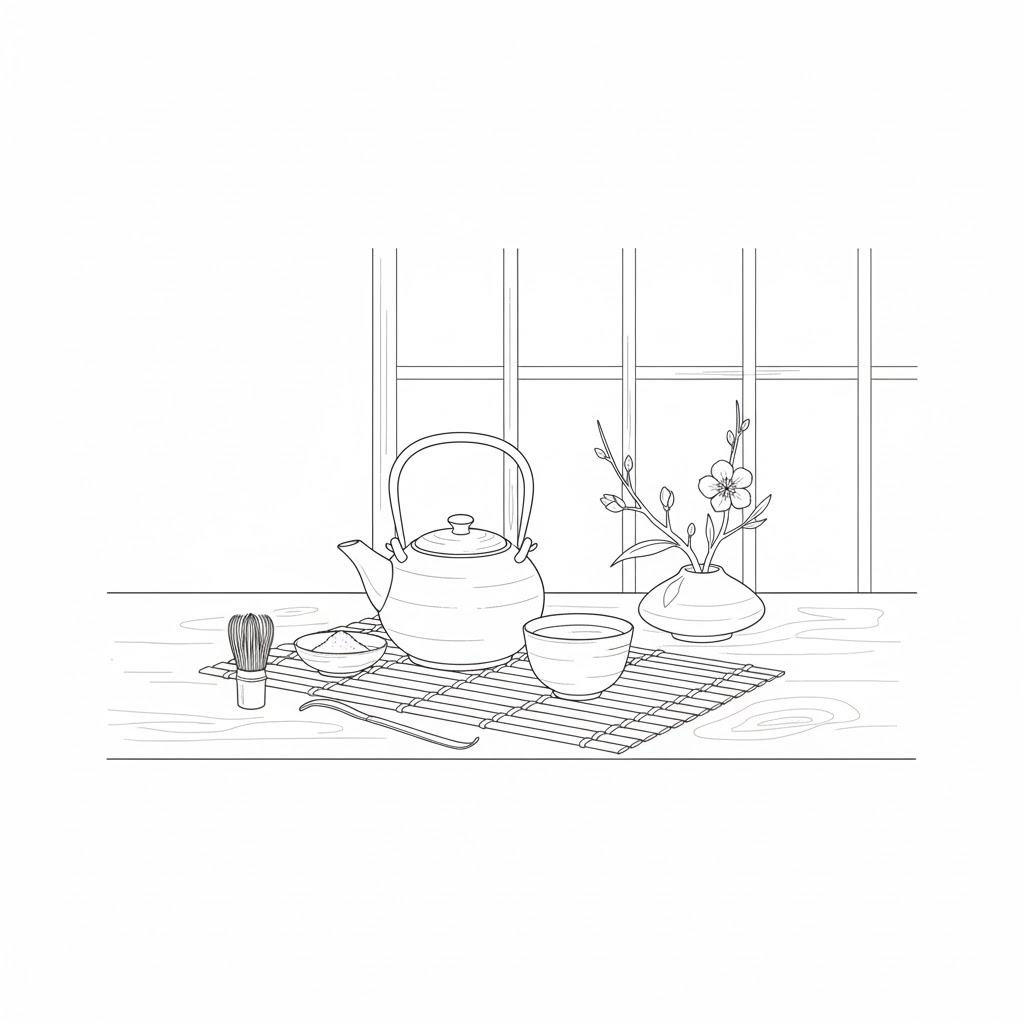
The image before us—a delicate line drawing of a traditional Japanese tea set—is more than just a collection of objects. It is a blueprint for mindfulness. It captures the essence of Chanoyu (the Way of Tea), a practice that has refined the art of hospitality and presence over centuries.
The Anatomy of Intentionality
Every object in a tea ceremony is chosen with a specific purpose, reflecting the season, the occasion, and the relationship between the host and the guest. In the illustration, we see the essential tools of the trade, each carrying its own history and weight.
- The Chawan (Tea Bowl): Notice the simple, sturdy curve of the bowl. In a ceremony, the bowl is held with both hands, its warmth grounding the drinker. It isn’t just a vessel; it is a canvas for the vibrant green of the matcha.
- The Chasen (Bamboo Whisk): To the left sits the whisk, carved from a single piece of bamboo. Its delicate tines are responsible for creating that signature frothy foam, a process that requires a rhythmic, meditative flick of the wrist.
- The Tetsubin (Iron Kettle): The centerpiece, the kettle, represents the element of fire and the transformation of water. The sound of water simmering in a traditional kettle is often compared to “wind in the pine trees.”
- The Chashaku (Tea Scoop): Lying gracefully on the mat, this slender bamboo scoop is used to measure the matcha powder with surgical precision.
These items aren’t merely “kitchenware.” They are instruments of a ritual designed to pull the practitioner out of the chaos of the mind and into the reality of the senses.
The Four Pillars: Wa, Kei, Sei, Jaku
To understand why someone would spend an hour preparing a single bowl of tea, we have to look at the philosophical foundation of the practice, established largely by the tea master Sen no Rikyū in the 16th century. He distilled the ceremony into four principles:
- Wa (Harmony): This is the relationship between the guests, the host, and nature. In the drawing, the small vase with a single flowering branch (Ikebana) brings the outside world in, reminding us that we are part of a larger, changing ecosystem.
- Kei (Respect): This involves acknowledging the value of everything—from the lowliest bamboo whisk to the most esteemed guest. It’s about recognizing the interconnectedness of all things.
- Sei (Purity): This isn’t just physical cleanliness, though the ritual washing of the tools is vital. It’s a symbolic “clearing of the slate” for the heart and mind.
- Jaku (Tranquility): This is the ultimate goal. It isn’t a forced silence, but a natural state of peace that arises when the first three pillars are in place.
“Tea is naught but this: first you heat the water, then you make the tea, then you drink it properly. That is all you need to know.” — Sen no Rikyū
While Rikyū’s quote sounds deceptively simple, the “properly” part is where the work lies. It suggests that if we do even the simplest tasks with 100% of our attention, we find a sense of completion that no amount of multitasking can provide.
Why “The Way of Tea” Matters Today
You might be wondering: How does a 500-year-old ritual apply to my life in 2026? We live in a world of “hyper-consumption.” We drink coffee while driving, eat lunch while answering emails, and listen to podcasts while exercising. We are rarely ever in one place at one time. The tea ceremony is the ultimate antidote to this fragmentation.
1. The Power of Single-Tasking
The ceremony demands that you do one thing at a time. You watch the steam. You hear the whisk. You smell the grassy aroma of the matcha. This sensory immersion acts as a “reset button” for the nervous system. It proves that productivity isn’t the only metric of a life well-lived; presence is.
2. Finding Beauty in Imperfection (Wabi-Sabi)
The aesthetic of the tea ceremony is rooted in Wabi-Sabi—the appreciation of the imperfect, impermanent, and incomplete. The handmade bowl in the drawing might have a slight asymmetry. In a real ceremony, a cracked bowl repaired with gold (Kintsugi) is often more prized than a flawless one. This philosophy teaches us to accept our own flaws and the “rough edges” of our lives with grace.
3. Ichigo Ichie: This Moment, Only Once
A central concept in tea culture is Ichigo Ichie, which translates to “one time, one meeting.” It reminds us that even if the same people gather in the same room to drink the same tea tomorrow, this specific moment will never happen again. The light will be different; the mood will have shifted. Treating every interaction as a “once-in-a-lifetime” event changes how we treat the people around us.
Creating Your Own “Tea Moment”
You don’t need a tatami room or a $500 iron kettle to bring this spirit into your home. The illustration shows us that beauty lies in the arrangement and the intention.
How to start your own ritual:
- Designate a Space: It doesn’t have to be a whole room. A specific corner of a table or a clean tray can be your “sanctuary.”
- Remove Distractions: Put the phone in another room. This is ten minutes for you and the steam.
- Engage the Senses: Choose a mug you love the feel of. Notice the color of the tea. Listen to the water boil.
- Focus on the Breath: As you wait for the tea to steep, take three deep breaths.
The Silent Conversation
There is a unique type of social connection that happens during tea. In many traditional ceremonies, conversation is kept to a minimum. Instead, the connection is forged through shared observation and mutual respect.
In a world that is increasingly polarized and loud, there is something incredibly healing about sitting in silence with another human being. It reminds us that we don’t always need words to understand one another. Sometimes, the act of sharing a bowl of tea is the most profound statement of peace we can make.
Conclusion
The line drawing we see here is an invitation. It invites us to put down the heavy baggage of our “to-do” lists and step into a space of deliberate calm. Whether you prefer a bowl of matcha or a simple cup of herbal tea, the lesson remains the same: Life is happening right now, in the steam rising from your cup.