There is a specific, primal magic in the act of draping a bedsheet over a couple of chairs. It is one of the first architectural feats we perform as children—a declaration of independence from the “big world” and the creation of a universe where we set the rules.
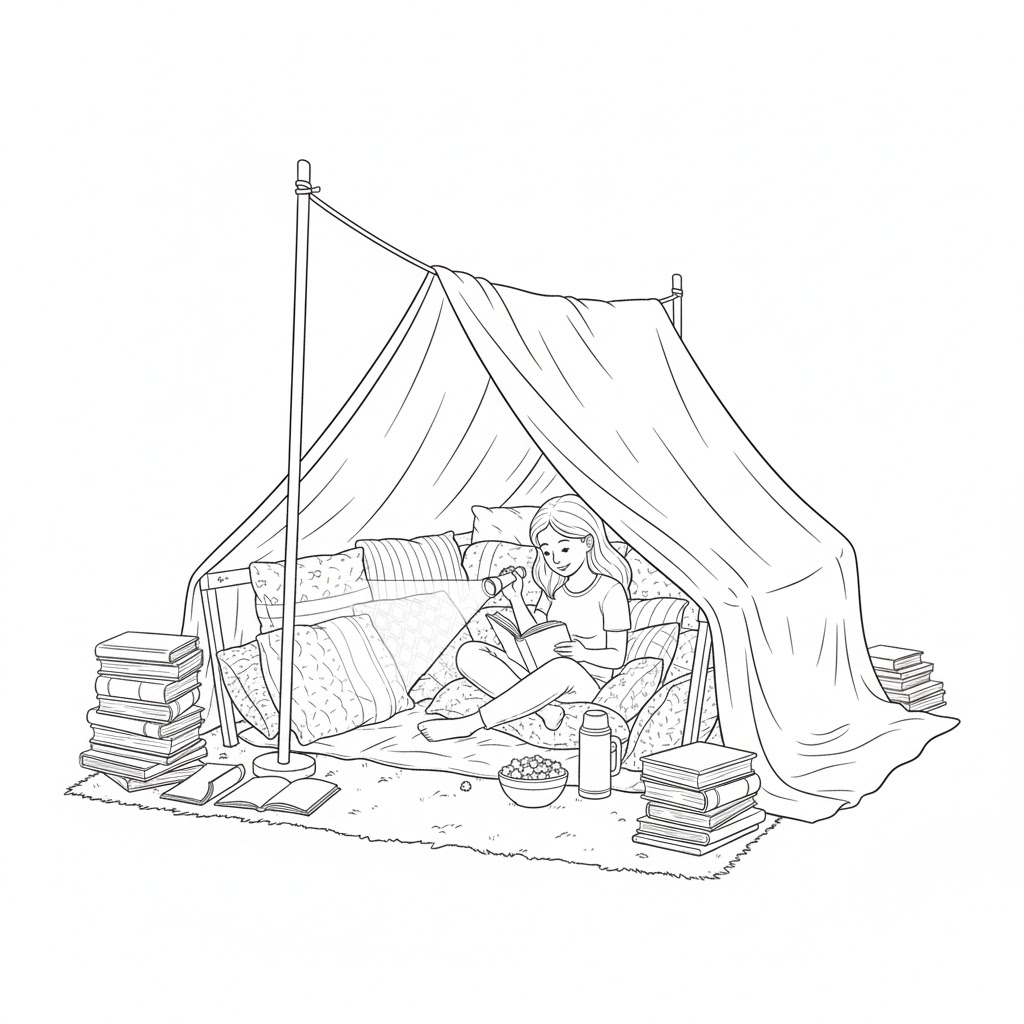
The image above captures this sentiment perfectly: a young girl tucked away in a DIY tent, surrounded by a fortress of books, a flashlight in hand, and a bowl of popcorn nearby. It’s a scene of ultimate cozy autonomy. But while we often categorize “fort-building” as a childhood pastime, there is a profound psychological and creative benefit to creating indoor sanctuaries as adults.
In an age of constant connectivity and open-concept living, the “Indoor Fort” is making a comeback as a tool for mindfulness, deep work, and digital detoxing.
The Psychology of Enclosure: Why Small Spaces Feel Safe
Humans have a complicated relationship with space. While we love the grandeur of high ceilings and wide vistas, our nervous systems are often hardwired to seek out “prospect and refuge.” This is an evolutionary psychology concept suggesting we feel most at ease when we have a clear view of our surroundings (prospect) but are tucked into a protected, enclosed space (refuge).
1. Sensory Regulation
Our modern world is loud. Visual clutter, the hum of appliances, and the glow of streetlights can keep our brains in a state of low-level “high alert.” A blanket fort acts as a physical filter. It softens the acoustics, dims the harsh overhead lighting, and narrows our visual field to just what is in front of us—whether that’s a novel, a sketchpad, or a bowl of popcorn.
2. Emotional Regression (The Good Kind)
In psychology, “regression in the service of the ego” refers to the ability to tap into childlike states to foster creativity and reduce stress. By physically entering a space that mimics a childhood “safe zone,” we give our brains permission to stop worrying about taxes, deadlines, and social obligations. We return to a state of pure play.
Anatomy of the Perfect Indoor Sanctuary
The illustration provides a blueprint for what a modern indoor retreat should look like. If you’re looking to recreate this for yourself (or a very lucky child), here are the essential components:
The Foundation: Comfort is King
Notice the pillows in the drawing—they aren’t just for decoration; they are structural integrity and comfort combined.
- Layering: Start with a thick rug or a yoga mat. Layer on top with duvets and every throw pillow you own.
- Ergonomics: Even in a fort, back support matters. Use the “v-shape” pillow arrangement to support your spine while reading.
The Shell: Physics and Fabric
The girl in the image uses a simple line-and-pole system.
- Lightweight Materials: Use flat sheets rather than heavy blankets for the “roof” to prevent sagging.
- Anchoring: Clamps, clothespins, and heavy books are the unsung heroes of fort engineering.
The Atmosphere: Low-Light Magic
One of the most charming details in the image is the flashlight. * Warmth: Avoid “cool white” LEDs. Opt for warm-toned fairy lights or a battery-powered lantern to create a golden, amber glow.
- The Scent: If you aren’t worried about the fabric, a nearby candle or a small essential oil diffuser (lavender or cedarwood) can transform the space into a multi-sensory experience.
The “Book Fortress”: A Sanctuary for Deep Reading
Perhaps the most striking element of the illustration is the sheer volume of books. They aren’t just inside the tent; they are stacked outside like defensive walls.
We are currently living through a “reading crisis.” Research shows that our attention spans have been fragmented by the infinite scroll of social media. Deep reading—the kind where you lose track of an hour while immersed in a narrative—is becoming a rare skill.
An indoor fort is a “Deep Reading Lab.” When you enter a confined space with a stack of physical books and no phone, you are setting a physical boundary against the digital world. The physical act of “crawling in” tells your brain: The distractions cannot follow me here.
Beyond Play: Use Cases for the Adult “Nest”
If you feel “too old” for a blanket fort, consider these rebrands of the same concept:
| The “Rebrand” | The Purpose |
| The Meditation Nook | A dedicated corner with a floor cushion and a heavy curtain to block out visual noise during breathwork. |
| The Analog Office | A space strictly for journaling, sketching, or long-form writing—no chargers or Wi-Fi allowed. |
| The Audio Sanctuary | A small, draped-off area optimized for listening to a full vinyl record or a high-production podcast without interruption. |
The Ritual of Dismantling
There is a bittersweet beauty in the temporary nature of a fort. Unlike a room renovation, a fort is an “event.” It exists for an evening or a weekend, and then it vanishes, leaving nothing but a few wrinkles in the sheets and a refreshed mind.
This transience encourages us to be present. Because the fort won’t be there tomorrow, we are more likely to stay in the moment, finish that chapter, and enjoy the crunch of the popcorn.
Conclusion: Build Your Own
The girl in the drawing looks content because she has curated a world that fits her perfectly. She has her light, her snacks, and her stories. In a world that constantly demands we be “bigger,” “faster,” and “more productive,” there is a quiet rebellion in choosing to be small, slow, and hidden.
Whether you use a high-tech pop-up tent or three kitchen chairs and a King-sized duvet, I encourage you to build a sanctuary this week. Grab a stack of books, leave your phone in the kitchen, and rediscover the joy of having nowhere to be but “inside.”